Bessemer Venture Partners Names Breaker in 2026 Defense Tech Roadmap

Bessemer names Breaker a frontier company in their 2026 Defense Tech Roadmap
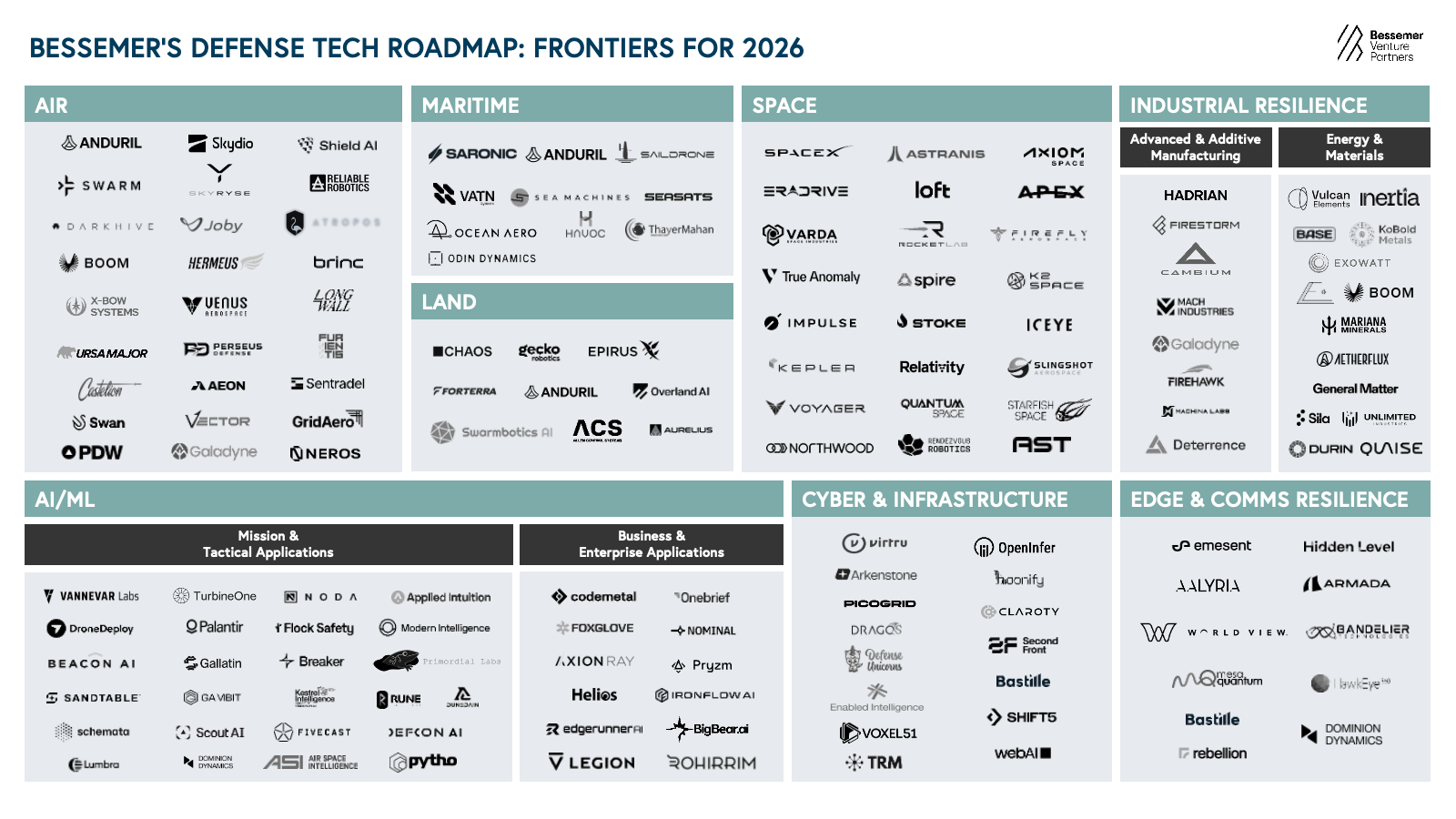
Bessemer Venture Partners just published their annual Defense Tech Roadmap, the most widely referenced investor framework in defense technology, and named Breaker alongside Anduril, Saronic, and NODA AI as a company defining the future of autonomous systems.
The roadmap identifies five frontiers that BVP believes will shape national security in 2026. Frontier one, "Autonomy moves from concept to combat," is where they placed Breaker.
Here's what they wrote
"The DoW has pursued vendor-agnostic orchestration for nearly two decades through various agencies and initiatives. What has changed in today's paradigm though is both the urgency and the art of the possible: the rise of mass autonomy in the battlefield has made the need for such solutions even more dire, and the current wave of AI technology has accelerated innovation to unlock autonomous collaborative teaming solutions that weren't viable previously."
"Others like Breaker allow operators to command and query autonomous systems through natural language over standard push-to-talk radios, eliminating dependency on bulky laptops or vulnerable networks."
That last sentence is the problem we built Avalon to solve. Operators shouldn't need screens, controllers, or data links to command robots. They should command them the same way they command human teammates, over a radio.
Why this matters.
BVP manages over $19 billion and has backed defense-tech companies from Rocket Lab to Auterion. Their Atlas publications, including the EMCLOUD index and Forbes Cloud 100, have become industry-standard frameworks that define entire sectors. Their Defense Tech Advisory Board includes the former CTO of Lockheed Martin, retired US Air Force and Space Force generals, and a former Director of Naval Intelligence. When BVP maps a category, the ecosystem pays attention.
What BVP identified.
The roadmap argues that the rise of autonomous platforms was "just one chapter of the story" and that the real challenge now is command and control across heterogeneous autonomous ecosystems, orchestrating missions across dozens of different platforms from different vendors, across air, land, and sea, alongside manned systems. They note that defense has pursued vendor-agnostic orchestration for two decades, but that AI has finally made it viable. Breaker is one of two companies they point to as solving this. The other is NODA AI, which they describe as a reasoning engine for task optimization and delegation.
The five frontiers BVP identified for 2026:
- Autonomy moves from concept to combat, where Breaker is featured
- AI permeates DoW workflows, mission-critical and enterprise back-end
- Advanced manufacturing, low-cost, scalable munitions and additive manufacturing
- Edge and network resilience, mesh networks, anti-jamming, alternative PNT
- Energy and materials independence, critical minerals, nuclear energy, supply chain sovereignty
BVP's thesis aligns with what we've been building toward since day one: the operator bottleneck is the most expensive capability gap in defense. Robots are proliferating faster than operators can control them. The answer isn't more operators, it's smarter software. Talk to robots like you talk to teammates. No screens. No controllers. No cloud. Just intent, over a radio, turned into autonomous action.